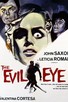
La Ragazza che sapeva troppo (The Girl Who Knew Too Much) (The Evil Eye) (1962)
Average Rating: 6.5/10
Reviews Counted: 7
Fresh: 5 | Rotten: 2
No consensus yet.
Average Rating: N/A
Critic Reviews: 1
Fresh: 1 | Rotten: 0
liked it
Average Rating: 3.7/5
User Ratings: 717
My Rating
Movie Info
Generally considered the first real giallo film, Mario Bava's stylish thriller stars Leticia Roman as Nora, who travels to Rome to visit her sick aunt. The aunt dies that night, and Nora ends up witnessing a murder. The police and kindly Dr. Bassi (John Saxon) don't believe her, since there is no body, so she goes to stay with her aunt's friends, the Cravens. Along the way, there are several more murders tied to a decade-long string of killings of victims chosen in alphabetical order by surname.
Feb 10, 1963 Wide
Oct 3, 2000
Watch It Now
Cast
-
Valentina Cortese
Laura Terrani -
Giovanni Di Benedetto
Prof. Terrani -
Letícia Román
Nora Dralston -
John Saxon
Dr. Marcello Bassi -
Dante DiPaolo
Landini -
-
ADVERTISEMENT
All Critics (7) | Top Critics (1) | Fresh (5) | Rotten (2) | DVD (1)
Bava, who'd once shot films for Roberto Rossellini and Raoul Walsh, used black and white for the last time on this project, and with its mastery of the noir vocabulary it helped establish the giallo.
The giallo gets its cinematic foundation in Mario Bava's wide-eyed "story of a vacation"
Plot and coherence aren't really so important as atmosphere and style and thrills, and these things [the film] possesses in abundance.
As expected, The Girl Who Knew Too Much has been infused with a compelling and thoroughly memorable sense of style that's ultimately revealed as the one bright spot within a film that's otherwise fairly interminable.
It's a bit plot-heavy for Bava, but it's still beautifully filmed.
It works as a homage to Hitchcock, but without the master's flawless power of storytelling.
Audience Reviews for La Ragazza che sapeva troppo (The Girl Who Knew Too Much) (The Evil Eye)
Super Reviewer
The usual Gialli trademarks are already beginning to take shape here, with the film focusing on a foreigner - in this case, twenty-year old American student Nora Davis - who travels to Rome to visit her ailing aunt and inadvertently witnesses a murder. Alongside this central plot device, which would be utilised by Argento in many of his greatest films, such as the three aforementioned, we also have the ideas of sight and perception; with the central protagonist unintentionally witnessing something that is shrouded in elements of doubt and abstraction, and thus having to prove what she saw to sceptical police officers and those nearest to her. Bava's film is also given a neat touch of self-referential sub-text; opening with a shot of the central character herself reading a Giallo murder mystery, casting some doubt as to whether or not the film plays out in the literal sense, or whether it is a merely a constructed reality, taking place in her own mind as she reads the book to herself. This is a thread of interpretation that is examined throughout by the filmmaker, with the title of the book itself, "The Knife", having an importance on the plot that perhaps surreptitiously suggest some element of imagined fantasy.
Once we get through those hectic opening sequences, which introduce the characters and a number of potential sub-plots that are essentially window-dressing to throw us off the trail, the film settles into the murder mystery aspect and the burgeoning relationship between Nora and her young doctor friend, Marcello Bassi. Through the relationship, Bava introduces a subtle comment on the Holmes vs. Watson partnership recast as a romantic dilemma, whilst also creating space within his story to let the audience catch up and think about the potential clues already collected in order to lead us to the eventual discovery of the killer's identity. The use of sight and Bava's directorial slight-of-hand is used meticulously for the initial murder sequence; with the director creating a literal feeling of hazy disconnection and a distorted perspective through a somewhat dated visual effect and the always masterful use of light and shadow. Although the actual effect - which replicates the look of ripples on a pond - might lead a more contemporary audience to giggle or cringe, it does tie in with the continual use of water-symbolism in Bava's work, from the final story in The Three Faces of Fear/Black Sabbath (1963), and A Bay of Blood (1971) most famously, as well as a somewhat cheap gag about marijuana cigarettes that will pay off in the film's closing moments.
Again, the use of humour taps into the spirit of Hitchcock, with intrigue, voyeurism, suspense and murder being reduced to mere complications in the continual romantic wooing of Nora by the charming Dr. Bassi. Nevertheless, the thriller aspects are what we remember most clearly; with Bava's always atmospheric direction, iconography and ability to create tension from the slightest movement of the camera. Once the credits have rolled, we release just how subtle much of Bava's use of sight and perception actually was; with a number of scenes leading on from a moment of confusion by the central character, in which she thinks she sees something that turns out to be nothing of the sort. Again, it shows the director playfully undermining the central character; presenting Nora as someone unable to trust her own eyes, and thus, unable to be trusted with the ultimate unravelling of the plot. Nonetheless, Bava also succeeds in throwing us into this enigmatic mystery; undermining our own perspective of the story by showing us important information early on, allowing us to feel superior to Nora with our benefit of a forewarning, only to then cast further doubt in our mind as the gallery of suspects mount up.
Though still something of a minor work for Bava, The Girl Who Knew Too Much is undoubtedly great; enlivened by the fine performances from the two leads, John Saxon (a cult actor with an impeccable list of credits) and the delightful Leticia Roman (I'm honestly quite smitten), and absolutely brimming with style and energy. The gag at the end is in-keeping with Bava's work, but certainly doesn't lessen the impact of the more thrilling scenes that came before, or the air of grand mystery and excitement suggested by his excellent approach to editing, cinematography and design. Beware that the film also exists under the title The Evil Eye; re-edited by Bava for the American market as more of a light-hearted romp (Tarantino calls it's a masterpiece). The version reviewed here is the original Italian version, a minor masterpiece of Giallo thrills, cinematic abstractions and an old-fashioned approach to storytelling that grips us from the start and never lets us go.
Super Reviewer
Discussion Forum
There are no discussion threads for La Ragazza che sapeva troppo (The Girl Who Knew Too Much) (The Evil Eye) yet.
What's Hot On RT
Bradley Cooper's Best Movies
Fast & Furious 6 is Certified Fresh
Fast & Furious cars gallery
Blockbusters ranked!
Featured on RT
- Critics Consensus: Fast & Furious 6 is Certified Fresh 29
- Red Carpet Photos with Vin Diesel, Michelle Rodriguez, Gina Carano and More 0
- Video: The Hangover Part III Cast Interviews 0
- Total Recall: Bradley Cooper's Best Movies 40
- Parental Guidance: Epic and Beautiful Creatures 2
- Comic Book Movies You Can Watch Online 9
- In Pictures: The Cars of Fast & Furious 0
Top Headlines
-
Evan Peters Joins X-Men: Days of Future Past
0
-
Toby Jones Talks Captain America: The Winter Soldier
0
-
The Poltergeist Reboot May Actually Be a Sequel
10
-
Will Forte Promises MacGruber 2
1
-
Universal Plans Timecop Reboot
2
-
Return of the Jedi Turns 30
1
-
Vin Diesel Says Fast & Furious 7 Will Take Place in L.A.
0


Top Critic