Yes, There Were Black People in the Old West
I don't know if this was the first blaxploitation Western. Indeed, Wikipedia doesn't include it in their list of blaxploitation films at all, though I'd say the list should not be taken as all-encompassing in any way. However, I would argue quite strongly that it fits
into the category. It's true that the movie takes place about a hundred years earlier. It's true that it's rural, whereas most blaxploitation is urban. And the closest we get to drug trafficking is a few drunk people. However, we do have a Righteous Black Man (and a less-righteous one) going up against The Man on the behalf of his people. There's a woman who just wants her man to be safe and doesn't understand why he has to get involved. There's even ineffectual law enforcement.
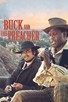
Our Righteous Black Man is Buck (Sidney Poitier), a Civil War veteran taken to helping wagon trains of black people go West and out of sharecropping and the Klan. There are, on the other hand, White Men Whose Names I Couldn't Determine who want all those black people to go back to, in this case, Louisiana and do the work raising cotton, leaving the wide-open spaces of the West to white men. (The Indians are pretty surly about this, as you might expect.) Buck encounters The Preacher (Harry Belafonte) while on the run from them. In fact, Buck steals his horse. But they get all that sorted out, and they decide to take back the money those white men stole from a wagon train and help its travelers safe through Indian territory and out the other side. As you might expect, there's some shooting involved.
Also Ruby Dee as Ruth, Buck's woman. She would like Buck to give up all this and run away to Canada with her. She doesn't think there's anywhere in the United States for black people to live without becoming slaves in fact if not in name. (She's not far wrong, given when she was saying this.) There's so little slave heritage in Canada as makes no difference, at least as far as African slavery is concerned, and it was abolished there long before it was here. Most Canadians had never even seen a black slave. At the beginning of the movie, she's nearly murdered by men trying to get at Buck through her; really, at their reunion, she's as surprised to see him as he is to see her. He's doing good work helping those people, but how much good work can he expect to keep doing before he gets shot?
Late in the film, Buck tries to raise common cause with the Indian chief (Enrique Lucero) through his interpreter, Sinsie (Julie Robinson). They are both oppressed by the White Man, he argues; surely they can work together and fight them. The first point the chief raises is that his people used to work side-by-side with the White Men, too, and now, they need their guns to fight against the White Man instead. He also points out, quite sensibly, that Buck himself used to be in the White Man's army. Buck concedes the point. It is, however, a good example of how "the enemy of my enemy is my friend" is at best an oversimplification and at worst just plain wrong. During the Civil War, Buck had common cause with the Union, which the Chief is all the White Man there is. On the other hand, now that the war is over, the White Man has had more interest in reconciling with Confederates than helping the slaves the Union freed. And either way, the wagon train is full of more settlers hoping to farm on Indian land.
High art it ain't, to be sure. Harry Belafonte seems not unfond of a bit of eye-rolling, and I really want to know what's going on with his teeth. It has hallmarks of both blaxploitation and Western-on-the-cheap. There's the mismatched antiheroes thrown together to fight against corruption. Well, that's common to both genres, and to several other besides. It also seems to me, on further reflection, that the theme of defending the poor and helpless through superior firepower is a common goal in both genres. The difference may be as simple as skin colour and social consciousness, though of course in the '70s, not all Westerns-on-the-cheap were free of either of those. It's all in the attitude, I guess.
November 2, 2010