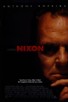
Nixon (1995)
Average Rating: 6.8/10
Reviews Counted: 60
Fresh: 45 | Rotten: 15
No consensus yet.
Average Rating: 6.3/10
Critic Reviews: 20
Fresh: 13 | Rotten: 7
No consensus yet.
liked it
Average Rating: 3.5/5
User Ratings: 12,087
Movie Info
Oliver Stone, the most outspokenly political American filmmaker of the 1980s and '90s, directs this epic-length biography of Richard Nixon, the 37th President of the U.S., who was re-elected by a landslide in 1972, only to resign in disgrace two years later. Taking a non-linear approach, Nixon jumps back and forth between many different periods and events, from Nixon's strict upbringing at the hands of his Quaker mother, through the many peaks and valleys of his political career, to his downfall
Dec 22, 1995 Wide
Jun 15, 1999
Buena Vista Pictures
Watch It Now
Cast
-
Anthony Hopkins
Richard M. Nixon -
Joan Allen
Pat Nixon -
Powers Boothe
Alexander Haig -
Ed Harris
E. Howard Hunt -
Bob Hoskins
J. Edger Hoover -
E.G. Marshall
John Mitchell -
Julie Araskog
Reporter #2 -
Brian Bedford
Clyde Tolson -
Tony Lo Bianco
Johnny Roselli -
Bill Bolender
Bethesda Doctor -
Tom Bower
Frank Nixon -
Larry Hagman
'Jack Jones' -
Corey Carrier
Richard M. Nixon at ... -
Michael Chiklis
Tv Director -
Julie Condra
Young Pat Nixon -
John Cunningham
Bob -
John Diehl
G. Gordon Liddy -
Donna Dixon
Maureen Dean -
Kevin Dunn
Charles Colson -
Richard Fancy
Mel Laird -
Fyvush Finkel
Murray Chotiner -
Annabeth Gish
Julie Nixon -
Joanna Going
Young Student -
Tony Goldwyn
Harold Nixon -
David Barry Gray
Richard M. Nixon at ... -
Charles Haugk
Staffer #2 -
Dan Hedaya
Trina Cardoza -
Edward Herrmann
Nelson Rockefeller -
Madeline Kahn
Martha Mitchell -
James Karen
Bill Rogers -
John Bedford Lloyd
Cuban Man -
Robert Marshall
Spiro Agnew -
John C. McGinley
Man in newsreel -
David Paymer
Ron Ziegler -
James Pickens Jr.
Black Orator -
David Hyde Pierce
John Dean -
Tony Plana
Manolo Sanchez -
Howard Platt
Lawyer At Party -
George Plimpton
President's Lawyer -
Victor Rivers
Cuban Plumber -
Marilyn Rockafellow
Helen Smith -
Saul Rubinek
Herb Klein -
Marley Shelton
Tricia Nixon -
Boris Sichkin
Leonid Brezhnev -
Drew Snyder
Moderator -
Paul Sorvino
Henry Kissinger -
Mary Steenburgen
Hannah Nixon -
Sean Stone
Donald Nixon -
Jon Tenney
Reporter #1 -
Ronald Von Klaussen
James Mccord -
Jack Wallace
Football Coach -
J.T. Walsh
John Ehlichman -
Bridgette Wilson
Sandy -
Robert Beltran
Frank Sturgis -
John Stockwell
Staffer #1 -
Oliver Stone
Voice-over during cr... -
Clayton Townsend
Floor Manager #1 -
James Woods
H.R. Haldeman -
Ling Bai
Chinese Interpreter -
Michael Herz & Llyod...
Fan #3 -
Harry Murphy
Fan #1 -
Fima Noveck
Andre Gromyko -
Chuck Preiffer
Secret Service Agent... -
Lenny Vullo
Bernard Barker -
Ric Young
Mao-tse-tung -
O'Neal Compton
Texas Man -
Wilson Cruz
Joaquin -
ADVERTISEMENT
All Critics (62) | Top Critics (22) | Fresh (45) | Rotten (15) | DVD (18)
As wayward and self-regarding as its subject, the film long overstays its welcome.
What it finally adds up to is a huge mixed bag of waxworks and daring, a film that is furiously ambitious even when it goes flat, and startling even when it settles for eerie, movie-of-the-week mimicry.
Without question, Nixon dwarfs everything in the American cinema since Schindler's List.
Nixon far overstays its welcome with an increasingly tedious final hour devoted largely to slogging through the minutiae of Watergate.
Nixon starts, like a horror movie, on a dark and stormy night, with the president prowling around a room of the White House like Dracula in his lair.
Thoughts of Hamlet, Macbeth and King Lear come to mind; here, again, is a ruler destroyed by his fatal flaws. There's something almost majestic about the process: As Nixon goes down in this film, there is no gloating, but a watery sigh, as of a great ship
Dense psychodrama of much-disliked U.S. president.
You could say that Nixon is Oliver Stone's Citizen Kane, and not necessarily mean it as praise.
The filmmaker's deftness at evoking theme and sentiment through editorial montages within individual dramatic scenes reaches an apotheosis here.
It's clear that Stone hates Nixon with a capital H.
A convincing blend of Shakespearean tragedy and Citizen Kane, Nixon paints the thirty-seventh President of the United States as a uniquely American tragic hero...[Blu-Ray]
Some of Nixon's scenes are standouts, but it's Hopkins' crazy rants that you won't forget.
A staggering work of empathy for Stone.
The combination of Oliver Stone and Richard Nixon, two paranoids from opposite ends of the political spectrum, is a match made in cinematic heaven.
For all its unwieldy temporal scope and narrowness of perspective, Nixon is an amazingly graceful beast, flawed yet invigorating, packed with enough material that will fascinate and irk moviegoers of all stripes for quite a time to come.
A riveting tragedy.
A hulking tyrannosaur of a movie, lusty and fierce, crashing around for all the world to see, majestic in its size and scope though it's also an instant anachronism.
The film could have worked. There was Hopkins and Allen to make it work. But maybe the curse of Nixon had a whammy effect.
The maverick director has outdone himself with a visually stunning, sweeping epic of the life of one of this country's most enigmatic political figures.
Hopkins doesn't try to look like or resemble Nixon, but he does wind up embodying him.
Hopkin's strangely effective imitation conveys a real sense of tragedy to this most infamous U.S. President.
_"Can you imagine what this man would have been had he ever been loved?"
Stone meshes together flashbacks, newsreels, black&white and color as well as different types of film, therefore creating a very complex piece. He turns Nixon's life into a real modern tragedy.
Riveting drama about a power-hungry politician brought down by guilt and paranoia.
Audience Reviews for Nixon
Super Reviewer
Super Reviewer
Movies Like Nixon
-
- Richard M. Nixon: Always remember others may hate you but those who hate you don't win unless you hate them. And then you destroy yourself.
-
- Richard M. Nixon: People look at you and they see who they want to be. They look at me and they see what they are.
Discussion Forum
What's Hot On RT
New Desolation of Smaug trailer!
Naomi Watts is Princess Di
The Hangover 3, The Purge, and More
Trailer for a squirrely heist flick
See what's on TV tonight
Latest News on Nixon
January 22, 2008:
Oliver Stone, Josh Brolin Prepare to Film BushHis Pinkville may have been spiked by United Artists, but Oliver Stone isn't wasting time moving on...
August 9, 2006:
Critical Consensus: A Brave New "World," A "Step" Down, And No Screenings for "Pulse" and "Zoom"This week at the movies, we've got Oliver Stone paying tribute to the heroes of 9/11 ("World...
Featured on RT
- Primetime Preview: Supernatural, Agents of S.H.I.E.L.D. and More 0
- RT on DVD & Blu-Ray: The Hangover Part III, The Purge, and More 11
- Primetime Preview: Beauty and the Beast, Sleepy Hollow and More 0
- NYFF: Joaquin Phoenix and James Gray talk The Immigrant 2
- Box Office Guru Wrapup: Gravity Stuns with Record $55M Launch 80
- Primetime Preview: Witches of East End, Once Upon a Time and More 4
- Weekly Ketchup: Disney Plans Live Action Cruella de Vil Movie 37
Top Headlines
-
Fox Animated Series, ABC Comedies Tumble in Sunday Ratings
0
-
Bong Joon-ho Reportedly "Furious" About Snowpiercer Cuts
0
-
Record-Setting Number of Films Competing in Foreign-Language Oscar Race
0
-
Woody Allen Cancels Blue Jasmine's India Premiere
1
-
Lionsgate Wants Gary Ross and Jennifer Lawrence's Burial Rites
1
-
ABC Plans Kevin Hart-Inspired Series
0
-
The Shining's Danny Torrance Is All Grown Up
1


Top Critic
The ironic thing about Nixon, therefore, is that it ultimately fails for exactly the opposite of all the normal reasons. Whereas JFK bashes you on the head for three hours until you break down and believe a totally spurious conclusion, Nixon doesn't really know what it wants to say, with its knee-jerk final act capping off an uncertain and rather aimless two hours prior to this. There are interesting moments or engaging ideas within said time, but ultimately the film is an admirable failure.
To his credit, Stone is upfront about the incomplete nature of existing accounts. The film begins with a statement about how relatively little has been made public from the Nixon administration, and how what follows is the closest possible replication of what happened based upon what is available. Even if Stone doesn't entirely follow through on this (for instance, in the plumbers scene), he deserves credit for announcing this upfront, rather than using it as an excuse to justify his conclusions. This was the mistake he made with JFK, embracing an already discredited theory and then trying to paint the film as being about the creation of myths, trying to start a dialogue that never materialised.
Nixon raises a number of interesting ideas around the nature and history of American politics, all of which are explored in some detail over the running time. One of the biggest themes is the relationship between the ordinary man and the establishment, something which is reflected in Nixon himself and in the students that protest against the policies of his government. Nixon is positioned as a man of humble birth, who had to work hard for everything he ever had and who, in his words, "never profited from public office". His plight is set against the fortunes of the Kennedy family, who are born with silver spoons in their mouths and seem to have success and popularity handed to them on a plate.
As much as Nixon paints himself as the common man, it becomes very clear very early on just how entrenched he is in the establishment, and how little he either can change it or is willing to change it. The political system is portrayed as one of deep-rooted, historical corruption, with a series of vested interests pulling strings, money changing hands and all kinds of loaded glances being exchanged. Stone can't resist slipping into caricature every so often - for instance, shooting all the scenes with Larry Hagman in deliberate shadow. But for the most part he lets the characters paint the picture, and it's not a pretty one.
One of the key scenes in Nixon comes when the President takes a late-night walk to the Lincoln Memorial, and is surrounded by angry students who are protesting against the Vietnam War. It's a painful scene to watch since it makes us resent both parties: Nixon comes across as out-of-touch, slippery and aloof, while the students are all obnoxious, slogan-spouting layabouts. But then Stone pulls the rabbit out of the hat, using our discomfort to explore the entrenched relationship between the state and the military, which results in near-constant demands for war being supplied by the state. It's a brief but gripping analysis of the military-industrial complex, leaving us a little wiser and a lot more depressed.
Nixon is anchored by the really good performance of Anthony Hopkins. It's an interesting performance because Hopkins manages to embody and inhabit Nixon, despite the fact that he doesn't really look like him. The voice may be a little different, but Hopkins nails Nixon's physicality, with the hunched shoulders, the forced toothy grin, the waving arms and the scowling mouth. He really captures the loneliness and insecurity of Nixon, with all his warmer scenes feeling like a thin disguise for the flawed, ruthless mind beneath the surface.
Hopkins is supported by a gallery of famous faces, of which a select few really stand out. Joan Allen really convinces as Nixon's wife Pat; she has to play the foil to Nixon's more gruesome moments, and gives the audience a way in through her occasional incredulity. James Woods is brilliant as H. R. Haldeman, being scarily driven in every scene and making us feel intimidated even when he's not saying anything. Bob Hoskins is enjoyable as J. Edgar Hoover; while he doesn't exactly nail the character, Hoover is more of a cipher in this film and Hoskins at the very least has fun with his lines. And Paul Sorvino, best known for his role in Goodfellas, is completely unrecognisable as the skin-crawling Henry Kissinger.
Everything that I've said thus far would make it seem like Nixon was a success, and that I had gone from being a Stone sceptic to an Oliver apologist. Sadly, this is not the case. Nixon is a film of interesting ideas - make no mistake about that - but it's also a film of great moments rather than an incrementally gripping story. In between those moments lies a meandering, shambling narrative that definitely overstays its welcome. Put simply, there is nothing about this film which justifies the three-hour running time.
I've often made the argument with biographical films that the best approach is to focus on one event or series of events in a person's life, and use them as a microcosm in which we can hint at wider events or aspects of one's character. The King's Speech, for example, worked because it was focussed around one event from which the ideas and themes could naturally flow. Had Tom Hooper attempted to tell the story of George VI from early life right up to that speech, it would have been far more cumbersome and less dramatically focussed.
While this film has a different focal point to Frost/Nixon, and is arguably more artistically ambitious, Ron Howard's work is ultimately superior because it has focus. It uses the Watergate interviews to tease out details about Nixon's character, as well as that of Frost and other figures in their respective professions. While Howard is giving you a little taste and allowing you to form your own conclusions, Stone prefers to browbeat us with information, trying to argue whatever point may be available by beating us and the plot into submission.
Even by Stone's standards, Nixon is ill-disciplined, not only in its length but in its lack of adherence to any kind of thesis. For the first two hours it stumbles from place to place, lurching between pantomime villain characterisation and a grown-up political drama. All the interesting ideas I mentioned before are raised in a specific scene or couple of scenes, but none of them are ever turned into a recurring theme or made a part of genuine foreshadowing. Then in the last hour, when Watergate begins to gather pace, the film turns into a knee-jerk hatchet job and ends far too abruptly.
This over-reaching on Stone's part has the unfortunate consequence of trivialising all the more sinister aspects of Nixon's rule. The film constantly treats the next scandal of the administration as if it is the worst thing possible, but Stone presents the events so clinically that it feels like a list rather than a downward spiral. Only the Watergate section has emotional weight, because it plays out at a pace that allows us to see the different shifts of the characters. Besides that, it's just a blur of lies, jargon and corruption with no way in for the non-political viewer.
For all the information he gathered for it, Stone has ultimately delivered a very empty film. He opens a discussion about Nixon, but because there's no focal point or commitment to a given theme, we come away feeling like we know as little (or perhaps even less) about Nixon than we did going in. The film reflects its central character's habits, jumping from one subject or line of reasoning to the next out of convenience or desperation - and every time it makes such a jump, it comes across as a little less structurally sound. Even with all the backstory and the flashbacks to Nixon's childhood, it all feels perilously thin.
Nixon is nothing more than an admirable failure, being as deeply flawed and elusive as its central character. It does boast several very good performances, and is the most successful of Stone's films about US presidents, being more interesting than JFK and less cartoonish than W.. But for all Stone's ambition in tackling the man, he ultimately comes away with empty hands and a very hollow result. Stone fans will lap it up, but the rest of us should opt for Frost/Nixon.