The LEGO Movie 2: The Second Part
Green Book
Widows
The Walking Dead
Log in with Facebook
OR
By creating an account, you agree to the Privacy Policy and the Terms and Policies, and to receive email from Rotten Tomatoes and Fandango.
Please enter your email address and we will email you a new password.
We want to hear what you have to say but need to verify your account. Just leave us a message here and we will work on getting you verified.
Please reference “Error Code 2121” when contacting customer service.
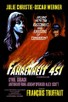
Fahrenheit 451 is an intriguing film that suffuses Truffaut's trademark wit and black humor with the intelligence and morality of Ray Bradbury's novel.
All Critics (35) | Top Critics (5) | Fresh (28) | Rotten (7)
Even at the science-fiction horror-story level, the movie fails -- partly, I think, because Truffaut is too much of an artist to exploit the vulgar possibilities in the material.
This 1966 film often looks good (it was Truffaut's first in color, photographed by Nicolas Roeg), but the ideas, such as they are, get lost in the meandering narrative.
With a serious and even terrifying theme, this excursion into science fiction has been thoughtfully directed by Francois Truffaut and there is adequate evidence of light touches to bring welcome and needed relief to a sombre and scarifying subject.
An underrated film, perhaps because it is less science fiction than a tale of 'once upon a time.'
Holy smoke! What a pretentious and pedantic production he has made.
Truffaut brought more cinematic acumen to this minute-long sequence than many filmmakers deploy in an entire feature.
It is as though Truffaut has drawn on everything he knows about cinema to express unshakable loyalty to the written word.
Truffaut's movie clearly suffered from a troubled shoot - Truffaut didn't actually know English - so his oddball take on the material succeeds in only fits and bursts.
Bradbury's 1954 vision of a totalitarian society where technology is worshiped and books are burned has been neutered and consigned to camp.
Truffaut faces Bradbury's abstractions head on, not as science-fiction but as humanistic fairy-tale
On the downside, it doesn't particularly feel like a Truffaut film, but on the upside, it's a decent entry in the sci-fi genre.
A marvelously courageous personal statement that becomes more fascinating with time.
Transposed to the screen by Truffaut and with an evoking score by Bernard Herrmann, Bradbury's terrifying vision of a future is a brilliant allegory that remains intelligent and pertinent even today, when books may not be destroyed but are scorned by people.
Super Reviewer
More like a jazz riff on the source material than a note by note translation, Traffaut's version actually adds interesting layers not intended by Bradbury. It's always cool to see how the past imagined the future and this imagination is well layered. For instance all the houses have TV antennas. Its a important feature of Traffaut's vision --- and its wrong technically. Nobody back then saw WIFI coming. On the other hand wall-sized flat screens are a right on the money prediction. On the whole the film is an uneven affair, and Werner's presence is disconcerting, yet as sci-fi it totally works. Its not just about burning books. Its about controlling the masses.
I'm coming to love Truffaut, but even my second time through this film - the first time was Grade 10 English class, after the book was assigned - I found it really boring, nowhere near as intriguing as the novel. Full marks for the production design and the source material, but definitely not the director's best work... far from it.
What has always impressed me about Bradbury's classic is his commitment to post-Enlightenment ideals. This film and Bradbury's novel obviously condemn book-burning. And the film lingers on the burning pages with an almost-overwrought, almost-melodramatic pathos. But it also shows Mein Kampf about to be torched. What Bradbury says is that in accordance with post-Enlightenment philosophy, when people are allowed free access to ideas, invariably the good ideas rise to the top and the bad ones fall. It is only after we trust in the goodness of human perception that we can see the burning of Hilter's work as tragic as the burning of Twain. What I've written so far is only about the source material because that's the only part of this film I liked. We never get to see Montag's journey; he goes from book-burner to reader in the matter of a quick night and a quicker conversation. I normally don't care about set design, but this is a shallow, half-hearted attempt at creating a Stepford Wives future, and we needed a greater commitment to this idea if Truffaut wanted to feature the design so prominently. Finally, I was remarkable unimpressed by Oskar Werner. His command of English was a stark contrast to all the characters around him, and he remained stolid, emotionless, and ineffective throughout most of the film's action. Overall, read the book; don't see the film.
View All Quotes
View All